Cryptocurrencies

Some of us have probably come across some article about how a certain celebrity made thousands of dollars investing on cryptocurrencies. Well, this article will not teach you how to do it, instead it will show you how to think critically about it and question it.

Cryptocurrency is “a digital asset that is constructed to function as a medium of exchange, premised on the technology of cryptography, to secure the transactional flow, as well as to control the creation of additional units of the currency.” (Chohan, 2017). It works as any other currency like we know, namely the Euro, the US Dollar, and so on, because it has monetary value, since it is a medium of exchange. And like other currencies, people can invest on it and purchase it.

However, the way people see the cryptocurrency market may not be the same as the way they portray the “regular” currency market, because despite being similar, the control over them works very differently. This keeps going when celebrities and influencers promote or endorse these cryptocurrencies, since they can actually change people’s minds and influence them to invest on a certain cryptocurrency, especially when they may be paid to do so. Consequently, this could lead to some phenomena like inflation which might be hard for some people to understand how it works and how we can take advantage out of it.

Also, people who have a lot of capital can actually influence a lot the price of a given cryptocurrency and there are a lot of techniques that they use to win a lot of money. (Quinlivan, 2018)

At the end, we must be well informed about what we want to act on, so that we don’t incur any risks due to our lack of knowledge.

References

Chohan, U. (2017, August 25). Cryptocurrencies: A Brief Thematic Review. From SSRN website: https://papers.ssrn.com/sol3/papers.cfm?abstract_id=3024330

Quinlivan, B. (2018, July 19). The Mysterious Manipulation of Crypto Markets and How to Manage. From Hackernoon website: https://hackernoon.com/the-mysterious-manipulation-of-crypto-markets-and-how-to-manage-5234e19e6e77?gi=464f5b731542
Brexit and Fake news

On 23rdJune 2016, the Brexit referendum was held to decide the permanence of the United Kingdom (UK) in the European Union (EU). There was a turnout of 72.2% and the results were close, as 51.9% of the citizens voted to leave, against 48.1% that wanted to stay. 

Despite this outcome, the decision came as a surprise to many. However, we have to take into consideration that, nowadays, there is a wave of misinformation that has the ability to influence political opinions. 

Technology is a powerful political weapon that targets people specifically according to their psychological profile. In this case, both “Remain” and “Leave” campaigns were accused of making misleading claims.

For instance, a “Remainer”, Alan Johnson claimed that “Two thirds of British jobs in manufacturing are dependent on demand from Europe”, while analyzing outdated information made by the Centre of Economics and Business Research. Therefore, this comparison was not possible, making his statement incorrect. 

On the other hand, the “Leave” campaign was much more aggressive and with a considerable amount of inaccurate and deceiving claims. 

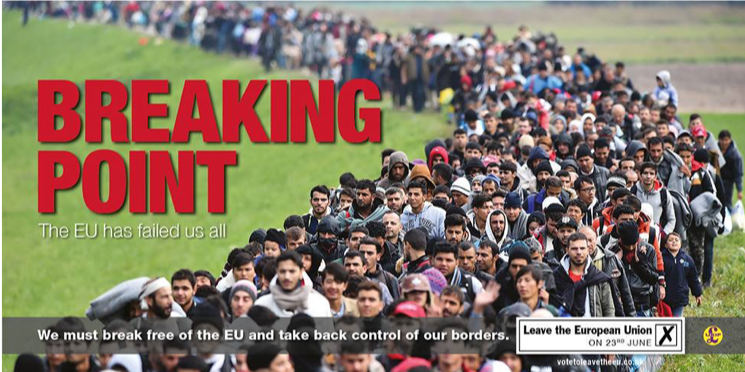
The ideas of hatred and xenophobia against migrants were able to spread due to the disinformation environment that lied within the British press. There were many first pages published that perceived migrants as a threat to the UK safety. So, the only way to fight this would be by exiting the EU. 

This idea of distrust in Europe was spread numerous times and was fed by fake and misleading propaganda such as: 

An anti-immigration billboard that was very controversial. It shows a queue of refugees hoping to reach Europe and claims “Breaking point: the EU has failed us all”, appealing to vote “Leave”. This poster was similar to fascist propaganda and promotes racial hatred, fear and urgency to vote. 

https://twitter.com/ukip/status/743382813542494212

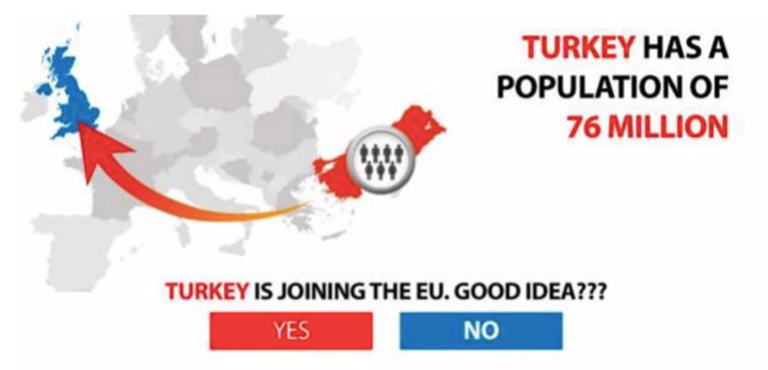
The adverts “Turkey(population 76 million) is joining the EU” and “Britain’s new border is with Syria and Iraq” were spread during the “Leave” campaign. The goal was to have stricter immigration legislation. However, this claim was false, as, at that time, negotiations between Turkey and the EU were in the first stage of a very slow process that is ongoing for more than 30 years and depends on the agreement of all EU members. 

Vote Leave Facebook ad

Another controversial and popular statement: “We send the EU £350m a week. Let’s fund our National Health Service instead”. This was considered a “clear misuse of official statistics” by The UK Statistics Authority, as it did not take in consideration the amount of money that the UK receives from the EU. The actual number would be £250 million a week. 

Other “Leave” ads stated that the EU wanted to ban tea kettles, regulate apps like Uber and restrict on-demand platforms such as Netflix.  Also, it was said that photos in the London Eye would be banned by the EU.  The environment and animal rights are also victims of these misleading campaign, as some suggested that the EU prevents people from protecting and speaking about polar bears.

To conclude, all these claims needed to be clarified as they are misleading and some even completely false and contributed to voters’ misinformation and ignorance. In fact, an indication of this is that one day after the referendum the most searched question in the UK on Google was “What does it mean to leave the EU” and right after that was “What is the EU?”. So, it is clear that misinformation is influencing political decisions and we need to tackle it. 

Webography:

Media Lies And Brexit

https://www.independent.co.uk/infact/brexit-second-referendum-false-claims-eu-referendum-campaign-lies-fake-news-a8113381.html

https://fullfact.org/europe/350-million-week-boris-johnson-statistics-authority-misuse/

https://edition.cnn.com/2016/05/23/europe/turkey-brexit/index.html

https://www.channel4.com/news/factcheck/factcheck-vote-leaves-dark-brexit-ads

Where did all the talk about “Fake News” come from?

Fake News, consisting of propaganda based on disinformation or hoaxes, have been around for a long time, since the Antiquity and Egyptians. There have been hoaxes spread by people or even governments all the time, including very important historical events like the French Revolution of 1789, when the french term for fake news at the time “canard” helped lead to queen Marie Antoinette decapitation. The pharaoh Rameses the Great also spread lies and propaganda depicting a tied battle as a stunning victory in the 13th century BC.

Then with the rise of newspapers fake news spread even more, especially during the twentieth century in the First World War, both the press and cinema were used as weapons of propaganda based on lies to help boost morale and win the war.

While this term has been around for a long time, since 2016 it has gained prominence. This is due to the presidential election in the United States, where more truly fake news were spread than ever. Some candidates, like the eventual winner Donald Trump, said and spread so many lies, hoaxes and misinformation that fact-checkers could barely keep up. The naivety of many voters also made them think the United States was in a worse state economically, criminally and socially than it was, and that Hillary Clinton was very corrupt and perhaps even involved in violent crimes and terror when she most likely never was. Social media helped spread the rise of fake news, where sensationalist posts, images and memes were spread millions of times, especially by older, more conservative voters.

However, to be fair there also fake news against Trump, for example a viral captioned image in where he supposedly said in a People Magazine interview that Republicans were the dumbest group of voters and therefore it would be easier to be nominated there. Trump also called and still calls most negative coverage of him “Fake News” even if they normally aren’t because he strongly dislikes the bias and hatred that most mainstream media publication in the United States have against him. He also called them the dishonest media and the lying press, insulting reporters, but even if he’d like a more positive bent and spin on his and his administration’s actions, he can barely do a thing about it since the media is protected by free speech clauses in the national constitution. Trump has even admitted he calls fake news merely negative, perhaps a little biased, news. This is one of the oldest dictators and strong man tricks, to call out the “Lying Press”.

So there are two main types of fake news, those are factually false, and fact-checker work hard to fight them, like Politifact and Snopes in the US, and Polígrafo in Portugal, and there are fake news which are negative news articles or opinion pieces about you, perhaps presented in a biased, pessimistic manner, and sometimes including predictions that will turn out wrong (like that Trump would cause a big economic recession). Always check carefully your news’ sources and always be sceptical and careful not just with straight-out lies, but also misrepresentation and bias.

Sources:

https://www.politifact.com/facebook-fact-checks/statements/2018/dec/18/blog-posting/no-
donald-trump-did-not-call-republican-voters-dum/

Weir, William (2009). History’s Greatest Lies. Beverly, Massachusetts: Fair Winds Press. pp. 28–41.
ISBN 978-1-59233-336-3.

Traqueia, Filipa, (2019, March 19). “Fake News”: Uma história tão antiga como a própria História.
Retrieved from https://poligrafo.sapo.pt/sociedade/artigos/fake-news-uma-historia-tao-antiga-
como-a-propria-historia

Charlton, Emma, (2019, March 6 ) “Fake news: What it is, and how to spot it” Retrieved from https://www.weforum.org/agenda/2019/03/fake-news-what-it-is-and-how-to-spot-it/

Vaccines: Threat to global health?

Vaccines are recognised as one of the most successful and important tools to protect people and to ensure public health. However, an increasing number of people perceive vaccination as unnecessary and even question its safety. These individuals are hesitant or deny vaccinating themselves and their family fearing possible side effects.

There has been a paradigm shift in healthcare. The power was transferred to patients, as they now can access all kind of information within seconds. Online research and social media are much more convenient than going to the doctor or reading medical articles. Nevertheless, it can be very dangerous.  

All these factors contributed to the creation of an environment in which there is a wide and fast spread of opinions. Internet allows people to expose their views without filters. In this way, misinformation emerges, as groups like anti-vaccination believers take advantage and divulge falsehoods that can lead to physical injuries or even death.

Anti-vaccination defends many theories that have constantly been debunked by science. It is believed that vaccines are toxic and can lead to several diseases such as autism.

 This belief started in 1998, when a study made by Andrew Wakefield claimed there was a link between MMR (measles, mumps and rubella) vaccine and autism. His work was considered fraudulent, the paper was retracted, and he was banned from practicing medicine in the UK. However, Wakefield moved to the U.S. and is now travelling around the country revealing his theory and influencing crowds.

Donald Trump agrees with this view and invited this doctor to his inaugural ball. Also, he has tweeted about it more than 20 times. In 2015, before being elected, he affirmed during a Republican debate that the child of one of his employees developed autism after being vaccinated. Since being elected, Trump has remained silent about this matter.

Countless studies proved otherwise, however this belief has persisted for decades and generated doubt and fear. This hesitancy lead to such low vaccination coverage, that it is far from the 95% needed to prevent measles outbreaks.

According to the World Health Organization (WHO), the global number of measles cases increased more than 30%, since 2016. In 2017, there were 110 000 measles deaths worldwide.

Just in Europe, where people can easily access vaccines and information, there were 82 596 cases of measles. In 2018, 72 deaths were registered in European countries alone. These are shocking numbers as there is a vaccine that can prevent this disease. Moreover, it is estimated by this organization that measles vaccination has prevented about 21.1 million deaths globally, since 2000.

The way people see public institutions is also changing. This, combined with the nature of the Internet, allowed the advent of conspiracy theories. For instance, it is considered that the government and the pharmaceutical industry have unknown interests and are hiding “the truth” from citizens.

It is very worrying knowing that people believe this and spread it worldwide.

Vaccine hesitancy is considered one of the biggest threats to global health in 2019, by WHO: “Vaccine hesitancy – the reluctance or refusal to vaccinate despite the availability of vaccines – threatens to reverse progress made in tackling vaccine-preventable diseases. Vaccination is one of the most cost-effective ways of avoiding disease – it currently prevents 2-3 million deaths a year, and a further 1.5 million could be avoided if global coverage of vaccinations improved”.

So, it is crucial to fight health misinformation, as it is a risk to our health.

Webography:

Kata, A. (2010). A postmodern Pandora’s box: Anti-vaccination misinformation on the Internet. Vaccine, 28(7), 1709–1716.

Kata, A. (2012). Anti-vaccine activists, Web 2.0, and the postmodern paradigm – An overview of tactics and tropes used online by the anti-vaccination movement. Vaccine, 30(25), 3778–3789.

https://www.independent.co.uk/news/world/americas/andrew-wakefield-anti-vaxxer-trump-us-mmr-autism-link-lancet-fake-a8331826.html

 Statistics:

https://www.who.int